
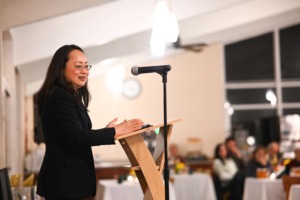
 Rev. Jihyun Oh, leader of the Presbyterian Church (USA)*, gave a stirring speech on what we are witnessing in our country and the call to work for peace in very specific ways at Stony Point Center’s 75th Anniversary Gala.
Here is an excerpt:
“…And so, thinking about these reports, these confessions and guided by the social witness policies that have been discerned by generations of General Assemblies that have gone before… the Presbyterian Church U.S.A., and following the policies of the denomination:
• We’ll continue to make peace by standing and advocating with and for those whose health and well-being are threatened because of and availability, or lack of availability and access to reproductive health care as well as health insurance coverage.
• We will continue to make peace by standing and advocating with and for LGBTQIA+ siblings and communities.
• We will continue to make peace by standing and advocating with and for immigrant and refugee communities.
• We will continue to make peace by deepening our care for creation and advocating for the care of all of creation.
• We will continue to make peace by working toward structural racial equity and systemic economic justice. Continuing to build on Matthew 25 commitments that many congregations and presbyteries, and synods have taken on.
• We will continue to make peace by working toward wholeness within communities with our domestic and global partners.
• Peace for those impacted by wars.
• Repair of harm and broken relationships.
• Safety for those impacted by violence.
• Healing for those struggling with well-being.
• And we will also continue to support the vocation of all leaders within the Church, no matter who they are, no matter how long their faith journey has been, or how they have come to be, part of the Church.
“We’ll do so by supporting the ministry of all of our presbyteries and synods as they support their leaders and faith communities of every kind within their bounds and care toward congregational vitality, so that all the communities, all the leaders who are part can be effective in God’s mission in us and in the world.
“And as a denomination in the Presbyterian tradition, the PCUSA believes we discern God’s will best in community, that is, fully represented and fully participating.”
See the rest of Oh’s address by clicking below. Our YouTube channel also holds videos from the rest of the 75th Anniversary weekend. We hope you enjoy them and would love to see you (again) soon!
* The Presbyterian Church (USA) wholly owns and operates Stony Point Center. It fully supports SPC’s open and affirming approach to being the “leaven for the bread” of all faiths and non-faith-based groups doing social justice work, including simply taking time off on retreat to heal, rest, and be together.
Keynote Address by Head of Presbyterian Church (USA)
Full Transcript of Rev Jihyun Oh’s Keynote Address at Stony Point Center’s 75th Anniversary Gala, including links to the referenced statements, declarations, and confessions she mentions:
As you heard, my name is Jihyan Oh. I am the stated Clerk of the General Assembly of the Presbyterian Church, U.S.A. I began my term on August 1st of last year, and I’m also the executive director of the Interim Unified Agency, which, for those of you who are Presbyterian, will know that it’s the unification between the former office of the General Assembly and the former Presbyterian Mission Agency, and folks have been asking why we are doing that unification. And it is so that we can serve the congregations, the leaders, the councils, the synods, and the presbyteries better, because if we’re really honest about it, people didn’t actually know that those are 2 separate agencies, anyway. And so we’re actually them in order to do the work better.
I mean, I recognize that not everybody here is Presbyterian, and I celebrate that. Celebrate it for the richness of this gathered group, for the Social Justice Summit, and also for the 75th anniversary of the Stony Point Center.
At the same time I am the stated clerk of the General Assembly of the Presbyterian Church, U.S.A. And so I will be doing a bit of a deep dive of nerdiness tonight to talk about where the church is, what the Church can do in times such as the one we live in now.
We are in a time when working together will be more important than ever. As West McNeill noted this morning.
I hope that will mean that those of us in the PCUSA will find ways to work closely with ecumenical, interreligious, and secular, and civil society partners in our efforts to enflesh God’s love and justice in the world.
I hope that will also mean that folks, groups, organizations of all sorts will reach out to those of us in the PCUSA and find welcome partners in the work of justice in the days ahead.
So part of these remarks tonight are taken from a letter that I and the co-moderators of the 226th General Assembly, the Reverend CC. Armstrong and Reverend Tony Larson, that we issued together in December of 2024 after the election, and as we were headed into the New Year, knowing what was likely to come.
And as I’ve continued in my new role. I’ve also been bringing to bear witnesses of past general assemblies on this particular time in the life of the world and the Church. Because the PCUSA is a denomination that is shaped by our Christian Biblical roots, our reformed theological roots, both of which give shape to our constitution.
And it’s also a denomination shaped by our General Assembly discerned social witness policies.
Our Constitution includes the book of Confession that contains 12 statements of faith from the Ecumenical Confessions, like the Apostles Creed and the Nicene Creed that are short and are shared across so many different traditions.
They include Reformation-era confessions like the Heidelberg Catechism, and the second Helvetic confession that speak to an era a long time ago, as folks were figuring out what it means to be church…when the church had in some ways stopped being church.
And there are also modern reform confessions, like the theological declaration of Barman and the Confession of Belhar that speak to the issues of the day, modern realities, like racism and apartheid and war. And they also contain confessions that are the Presbyterian Church, U.S.A.’s own. And the predecessor denominations like the Confession of 1967,and the brief statement of faith.
Those confessions, all taken together remind us that in every season regardless of what is happening, in every season, we are called to be the Church, the body of Christ in and for the world, worshiping God, and gratefully serving and acting in response to God’s grace.
In this time in the world, when we are being asked to give allegiance to human leaders, to unjust ideals of dominance, and nationalistic perversions of Christian faith over and against faithfulness to God – in and through these confessions we join other Christian traditions in declaring that the God whom we know in Jesus Christ is sovereign, that God alone is Lord.
In the PCUSA, that declaration that God alone is Lord became contextualized in a policy statement titled, “God alone is Lord of the Conscience,” adopted by the 200th General Assembly in 1988.
This is a policy statement that has become important and will likely continue to be important in the days ahead.
It’s the policy statement on religious liberty and has served and continues to serve as the basis for court cases involving religious liberty, for which the General Assembly of the PCUSA has been either a party or a friend of the court.
And that includes a lawsuit on religious liberty on which the General Assembly of the PCUSA joined several dozen other parties as a plaintiff against the rescission of the “sensitive locations” memo. The first hearing for that lawsuit was held yesterday at 10 AM in the District Court of Washington, DC. And we are still waiting on an opinion by the judge. In that case, as a preliminary hearing on an injunction. So we hope that that will be coming in the days ahead.
But the effect of an injunction for that lawsuit, because through me the General Assembly of the Presbyterian Church, U.S.A has signed on, along with the Mennonite Church, and the UMC, various conferences, and so many other groups…if the injunction is granted, all of our churches and faith communities that belong to the Presbyterian Church, U.S.A. will have that injunction be effective for them…so that the sensitive locations memo rescission is no longer applicable.
Part of this. What this means is that when our theology and practice of faith differs from what others might believe it should look like, on behalf of the General Assembly, it is declared that we are called:
- to welcome the stranger
- to include all in the life of the Church and the world, regardless of who they are, or how they are embodied
- to work toward the full participation and representation of the diversity that is part of the Church
- to lift up voices of those long silenced
- to work toward equity in all areas of life and faith
- to care for creation
It is done out of the conviction that God alone is Lord of the Conscience, and no person or institution can compel our faith to look different than how we have discerned God is leading us through the Holy Spirit. It does not matter who that leader is. It does not matter what that institution is. We are compelled through the Holy Spirit, the way God leads us, not by how those human leaders, or that institution compels us.
God alone is Lord of the Conscience.
And again, in this time, when some would claim that the Christian life is one that must withdraw from the world to be apart or even over and against the world, lest we somehow lose our righteousness and our salvation.
In and through those Confessions in our Constitution, we join other reformed Christians in recognizing our common call to be in the world, and to make God’s love and justice visible and real in the world.
This also means that we believe the Christian call is not to seek political power for ourselves and for our own good; that we don’t seek political power to maintain dominance, but we do so to act in the world toward God’s wholeness and peace, that we act in a way that uses the policies and the advocacy, and the power and the authority that we can muster in order that we are working towards God’s wholeness and peace in the world.
The Confession of Belhar in particular, that was written by our siblings in South Africa in a time of Apartheid, speaks to this calling, declaring that the Church must stand by people in any form of suffering and need. The Church must witness against and strive against any form of injustice, so that justice may roll down like water and righteousness like an ever-flowing stream.
The church, as the possession of God, must stand where the Lord stands, namely against injustice and with the wronged. The Church must witness against all the powerful and privileged, who selfishly seek their own interest, and thus control and harm others.
We also join other reformed Christians in recognizing that all believers are called to the vocation of discipleship. The priesthood of all the baptized. That means “being church” is not about the pastor doing all of the work, or the people who have gone to seminary, or the people who have long years of experience, or the people who have always belonged to the Church. It means that all who are part of the Church are called to the work of discipleship.
That means “being” church takes all of us, and each of us being active disciples in word and in deed.
That means that all of us, all those who are part of the PCUSA, General Assembly agencies and entities, synods and presbyteries, congregations and individuals who are members and participants of the PCUSA, alongside our partners, are called to discern and plan and collaborate, to show up and act, to stand with, and for those who are most vulnerable.
It will take all of us, and each of us, the whole church and and all of society, working together, to imagine how to enflesh God’s love and justice as good neighbors and to live that out.
One of the reports that has been reemerging as an important policy statement for this current time is “Peacemaking: The Believer’s Calling.” This was actually approved by the General Assembly of a predecessor denomination commonly known as the Northern Church, the United Presbyterian Church in the U.S.A. at its 192nd General Assembly in 1980. [Editor’s note: This is the predecessor denomination that founded Stony Point Center.]
Through its adoption, the General Assembly at that time stated what we believe—that we believe as a Presbyterian Church that God wills peace, shalom, total well-being, wholeness, fulfillment, health, joyous harmony.
The Biblical word for peace is shalom, which comes from the same root as the term wholeness. And when they talk about this wholeness, it is not just a lack of conflict as peace. It’s not an unjust or enforced peace, but a deep wholeness for all, including creation.
And the report goes on to say three things. The Church is faithful to Christ when it is engaged in peacemaking. And that our structures of military might, economic relations, political institutions, and cultural patterns failed to meet the needs of our time.
Y’all, this was from 1980.
I know, I said. Y’all, I’ve been living in the South for a long time. I grew up in Kansas, but I’ve been living in the South for a long time. Y’all, this was written in 1980,
Saying that our military might, our economic relations, our political institutions, and our cultural patterns failed to meet the needs of our time. It is in some ways true today, in many ways true today.
And so I imagine that those who wrote this report might say to us, the Church is faithful to Christ when it is engaged in peacemaking, and it is still faithful when it engages in peacemaking.
The report also went on to say that the Church is obedient to Christ when it nurtures and equips God’s people as peacemakers. And that equipping as peacemakers as those who are working towards wholeness, those who are working towards deep harmony and joy, those who are working towards economic equity, and those who are working towards gender equity, and those who are working towards folks feeling welcome and belonging in the spaces where they are and live, that nurturing and equipping God’s people to do that work is obedience to Christ Jesus. Even now.
And finally, it says, the Church bears witness to Christ when it nourishes the moral life of the nation for the sake of peace in the world.
That voice, that voice that calls and invites a nation into a moral life that is a life of abundance and not scarcity, a life of peace and not conflict and war, a moral life that envisions plenty for all instead of fighting over scraps, a moral life of safety and dignity and respect for all persons. That ought to be the voice that the Church exercises in this time.
And this report reminds the Church even now, that that is how we bear witness to Christ Jesus in the world.
And so, thinking about these reports, these confessions and guided by the social witness policies that have been discerned by generations of General Assemblies that have gone before… the Presbyterian Church U.S.A., and following the policies of the denomination:
- we’ll continue to make peace by standing and advocating with and for those whose health and well-being are threatened because of and availability, or lack of availability and access to reproductive health care as well as health insurance coverage.
- We will continue to make peace by standing and advocating with and for LGBTQIA+ siblings and communities.
- We will continue to make peace by standing and advocating with and for immigrant and refugee communities.
- We will continue to make peace by deepening our care for creation and advocating for the care of all of creation.
- We will continue to make peace by working toward structural racial equity and systemic economic justice. Continuing to build on Matthew 25 commitments that many congregations and presbyteries, and synods have taken on.
- We will continue to make peace by working toward wholeness within communities with our domestic and global partners.
- Peace for those impacted by wars.
- Repair of harm and broken relationships.
- Safety for those impacted by violence.
- Healing for those struggling with well-being.
- And we will also continue to support the vocation of all leaders within the Church, no matter who they are, no matter how long their faith journey has been, or how they have come to be, part of the Church.
We’ll do so by supporting the ministry of all of our presbyteries and synods as they support their leaders and faith communities of every kind within their bounds and care toward congregational vitality, so that all the communities, all the leaders who are part can be effective in God’s mission in us and in the world.
And as a denomination in the Presbyterian tradition, the PCUSA believes we discern God’s will best in community, that is, fully represented and fully participating.
And it’s sort of the joke around the Presbyterian circles is, how do you know you’re Presbyterian? Because we love committees.
We don’t love committees just because we love meetings. (Maybe some of us do.) But we meet in committees to discern God’s will because we believe that a single individual cannot fully discern God’s will, because we can only see part of what God is doing, that we need community. We need each other. We need the diverse lens that each person brings to their life and their experiences and the ways that they have engaged the world and different relationships and with God. That’s how we discern God’s will more fully.
And as a community that believes that we discern God’s will best that way when we are fully represented and fully have people who are fully participating. We will have to continue to do our own work toward full inclusion and participation of all communities that are part of the PCUSA. We will continue to listen for and to voices, long silenced, as part of our life together, as part of our processes for discerning our voice and witness in the days ahead.
Doing all of this will mean both recovering and rediscovering the wisdom of the past—something that I think we have been doing this weekend as we’ve been hearing the stories and the wisdom of the past at Stony Point Center.
It will also mean recontextualizing what needs to be lived into in a new way in the present. I think again, that’s a question. Maybe that is live for so many of us. What does it mean to bring the wisdom of the past and to recontextualize for this day, and how it applies now.
And I think we’ll also mean opening ourselves to imagine something new for the future, even when the way forward seems hopeless, and that future looks so very far away.And it may take some experiments, some good questions and good hypotheses, and knowing what variables to tweak as we do those experiments, so that we are learning something that God is teaching us, that the world is trying to teach us along the way.
It will take remembering that even before the church was Church, those who belong to God were called to be a blessing to others, not merely to be chosen, but to be a blessing to others. And they were called:
- to welcome strangers
- to care for widows and orphans
- to resist the urge towards cycles of violence, and to interrupt those cycles of violence
- to look toward God’s reign
That call continues now and into the future, even if the Church were to cease to exist.
And doing all of this imagining and recontextualizing, and remembering the past, and organizing and acting and being for love and justice in the world, will take good partnerships, and being good neighbors.
One of my favorite confessions, The “Theological Declaration of Barmen,” written by Karl Barth and many others in the time of Nazi Germany, reminds us that there are no areas of our life in which we would not belong to Jesus Christ, no areas in which we would not need justification and sanctification through Christ Jesus, no area that would fall outside God being Lord.
And so the Church will entrust ourselves to God. And place our hope in God, even as we discern and plan for the days ahead.
And I hope that communities and partners will continue to reach out, and that we will also continue to reach out to do this work together.
Thank you.