
At the Social Justice Summit held here at Stony Point Center during the 75th Anniversary Weekend, we were inspired by the brave and true words spoken by Rev. West McNeil of the Labor-Religion Coalition in their powerful opening keynote address. See below for highlights. Watch the video to hear the rest of West’s reflections.
Rev. West McNeil, April 5, 2025
Stony Point Center Social Justice Summit
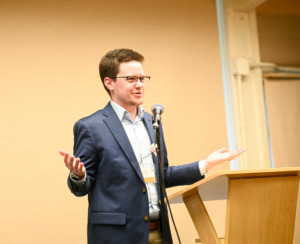 “…one of the most important things that we can be doing in this moment is building and deepening our relationships across the different organizations and issues that we work on and across the many different lines of division that have been exploited by our opponents throughout history to weaken us and to confuse us. And by that, I mean divisions based on race, age, religion, sexual orientation, nationality, etcetera.
“…58 years ago, on April 4th 1967, Dr. King spoke at Riverside Church in New York City, and gave what is now known as his “Beyond Vietnam” speech. This was a year to the day before he was assassinated. [It was] in that last year of King’s life, when he came out forcefully against the Vietnam War, and began to organize that original Poor People’s Campaign. His work during that time is a lot less familiar to many Americans than [the rest of] his work and words. ….
“Mainstream culture doesn’t like to talk as much about this part of King’s legacy when he was much more explicitly confronting the very roots of our economic system and confronting the war machine. King himself described his change of orientation at this time as a shift from civil rights to human rights. He recognized that the victories of the Civil Rights movement had integrated black Americans into a fatally flawed system.
“In May of 1967, Dr. King said in a speech to his staff,
…we have been in a reform movement, but after Selma and the Voting Rights Bill we moved into a new era which must be the era of revolution. We must recognize that we can’t solve our problem now until there is a radical redistribution of economic and political power.
This “Beyond Vietnam” speech was a speech that some of his friends and allies really did not want him to give. They predicted that coming out against the war would invite a backlash from the politicians and newspapers and other elites who had finally started to become allies on civil rights.
“And their warnings were right.
“There was a heavy cost to the choice Dr. King made to tell the truth about Vietnam. But he did it because he knew there actually was no other choice. First of all, as a Christian, he believed he could not be silent in the face of the immorality of the United States’ actions in Southeast Asia. He said in that speech,
…because I believe that God is deeply concerned, especially for God’s suffering and helpless and outcast children, I come tonight to speak for them. This I believe to be the privilege and the burden of all of us who deem ourselves bound by allegiances and loyalties which are broader and deeper than nationalism. And which go beyond our nation’s self-defined goals and positions. We are called to speak for the victims of our nation, for those it calls its enemy. For no document from human hands can make these humans any less our brothers and sisters.
“In addition to that basic moral conviction, Dr. King knew that we can’t tackle what he called the triplets of racism, materialism, and militarism in isolation from each other. The war in Vietnam was taking United States resources and attention away from the war on poverty. And because of white supremacy, black soldiers were killed in Vietnam at a disproportionate rate. Dr. King understood that fundamentally, it was the poor of all races of the United States who were being sent to kill and to be killed by the poor in Vietnam. King preached that all these issues are tied together and perpetuated by our nation’s sick and distorted morality. We, as a nation, must undergo a radical revolution of values. King said in that speech,
We must rapidly begin the shift from a thing-oriented society to a person-oriented society. When machines and computers profit, motives and property rights are considered more important than people, the giant triplets of racism, materialism, and militarism are incapable of being conquered. A true revolution of values will soon look uneasily on the glaring contrast of poverty and wealth. A nation that continues year after year to spend more money on military defense than on programs of social uplift is approaching spiritual death.
“Hearing these words, 58 years later. one has to ask, how much further has our nation traveled down the road to spiritual death?”